
Getting ready for Concrete Pumping in College Station Texas?
Evolution Concrete BCS treats concrete as a job with a deadline built in once the material starts moving for College Station Texas homes.
Send us a note to start with the size, the shape, and the access.
Concrete Gives You One Chance to Get It Right
Owners and builders researching Concrete Pumping in College Station Texas picture the hardened result before the work begins, but the work that decides how it turns out happens in a short window. Concrete starts to set from the moment water meets cement, so everything it needs has to be ready before it arrives.
Evolution Concrete BCS approaches Concrete Pumping by working out the timing first and each earlier step is timed to be ready.
Concrete Is a Recipe, and the Recipe Has Reasons
Every batch is a measured recipe, not a guess. Strength, workability, and durability can be adjusted by changing the proportions and adding admixtures, and it helps to talk through the application before placing the order. A simple slump test shows how workable a batch is when it arrives, and a plasticizer, not extra water, is the proper way to improve flow.
Special ingredients allow concrete to handle conditions that a basic mix would not. Air-entraining agents help concrete resist freezing and thawing, plasticizers improve flow without adding water, and retarders slow the set in hot weather, and adding the wrong product can cause more trouble than it solves.
When a Pump Is Needed and When a Chute Is Enough
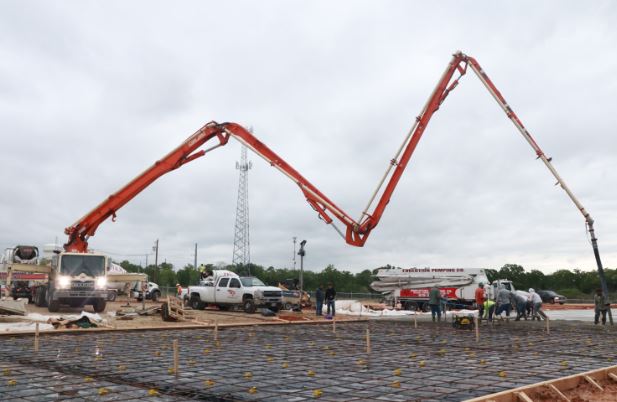
If a truck can back up to the forms, the chute does most of the work, though backyard patios, pool shells, and elevated slabs are often out of reach. Each pump type has its own reach, capacity, and setup requirements, and the site has to be able to support the weight of the equipment.
What Happens on Site When a Pump Is Used
The first step of any pump job is deciding where the pump and the trucks will stand. Pump lines should be supported so they do not shift or whip during the pour, and the person running the pump needs a clear view of the boom and the placement area. The rate of placement sets the pace for everyone else on site, and good coordination makes the pace an advantage.
Safety Is Part of the Pour Plan
Few jobs bring so many moving parts together in so short a time. Boots, gloves, and eye protection are standard for anyone working in wet concrete, and a spotter guides trucks in tight spaces.
Ground Preparation Is Half the Job
The soil beneath a pour is part of the structure. Across much of the state, the soil is expansive clay that swells when wet and shrinks when dry, so proper site drainage and steady moisture around a foundation are part of the plan. Rebar and wire mesh hold cracks tight and add strength, and the layout is checked before the truck arrives, because nobody can adjust it afterward.
Placing Concrete in Heat, Wind, and Sudden Rain
In summer, concrete stiffens quickly in the drum and in the forms, so placement is planned to beat the heat. Fresh concrete loses moisture fast in wind and sun, so protection is needed, and curing compound or wet coverings help the surface harden evenly. A cloudburst during a pour is an emergency, so covers are kept on hand, and rescheduling a pour for a better day is a normal and sensible decision.
Finishing, Joints, and the Truth About Cracks
The finishing steps happen in a fixed order as the concrete stiffens. Each finish has its own timing, and it has to be done at just the right moment, and a skilled finisher reads the concrete as it stiffens. Control joints cut into the surface create planned weak lines so cracks form there, and a few fine cracks do not mean something went wrong.
Concrete Around the Home
Residential concrete work covers a wide range of projects. A house slab is the foundation of the structure and needs careful design for the soil, and the details differ from job to job. Reaching a patio or pool behind a house can be difficult for a truck, and walking the site with the contractor helps spot obstacles early.
Foundations, Parking Lots, Drilled Shafts, and Tilt-Up Panels
On commercial and industrial sites, pours involve more volume, more people, and more rules. A drilled shaft is a deep column of concrete poured into a bored hole to carry heavy loads, and inspectors may be on site for key stages of the work. If deliveries are late, a cold joint can form where the new concrete meets the old, and that coordination is a large part of what a concrete contractor provides.
Local, State, and Federal Concrete Projects
Streets, highways, and bridges are built to standards that come from the public owner, and the contractor has to follow them exactly. Night work is common on busy roads to reduce the effect on traffic, and good documentation is part of the product.
Understanding Ready-Mix Supply and Delivery
A batch plant measures the ingredients to the recipe and loads the truck, which keeps the mix turning on the way, and each truck carries a limited amount, so large pours need several loads. The order should take into account the shape of the forms, the depth, and the subgrade, and the placement team has to be ready for each truck as it arrives.
Renting a concrete truck or pump raises its own set of questions. Access, ground conditions, and overhead clearance decide whether a machine can work on a given site, and these are questions to settle well before the day of the pour.
A busy pour day is also a busy day for the neighborhood. Keeping the street clear and the washout away from storm drains, shows respect for the people who live next to the work.
Leaving the Site in Good Order
After finishing, the site still needs attention. Leftover concrete and slurry are collected and disposed of properly, and the new concrete needs to be protected from traffic and weather while it cures. Where inspections are required, the contractor arranges them, and concrete that is properly placed and cured will last for decades.
The Starting Point for a Pour That Goes Smoothly
With Concrete Pumping planned for a site in College Station Texas, Evolution Concrete BCS can start with a conversation about the site, the access, and the size of the pour. Make contact to begin, and the next step will follow from there.