
Thinking through Concrete Pouring in College Station Texas?
Evolution Concrete BCS works out the forms, the placement method, and the timing before the first truck arrives across College Station Texas homes.
Start a conversation to talk about the site and how the concrete will reach it.
Why Concrete Work Is Planned Backward From the Pour
Owners and builders researching Concrete Pouring in College Station Texas are looking at the end product, a solid and level surface, but the work that decides how it turns out happens in a short window. Concrete starts to set from the moment water meets cement, and a good plan makes sure no one is waiting for forms, steel, or access when the truck backs in.
Evolution Concrete BCS approaches Concrete Pouring by working out the timing first with the ground work following from those answers.
Ready-Mix Basics Every Buyer Should Know
Cement, aggregate, and water combine to make a material that hardens into stone. Strength, workability, and durability can be adjusted by changing the proportions and adding admixtures, and the supplier needs to know what the concrete will be used for. A simple slump test shows how workable a batch is when it arrives, and a plasticizer, not extra water, is the proper way to improve flow.
The mix can be tuned beyond cement, stone, and water. Each additive has a purpose, and the supplier can explain which ones suit the job, and it pays to ask what is in the mix and why.
Access Decides the Placement Method
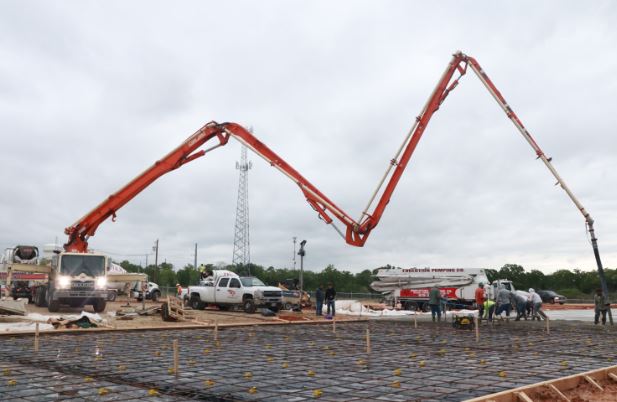
Where access is easy, direct placement is the most efficient method, and that is where pumping comes in. Each pump type has its own reach, capacity, and setup requirements, and the site has to be able to support the weight of the equipment.
Boom Reach, Line Length, and Preparation for Pumping
The pump looks simple from the street, but the setup takes planning. Long hose runs add friction, so the mix must be able to travel the distance, and the area around the equipment should be kept clear of anyone not working on the pour. At pumping speed, forms, steel, and finishers all have to be ready before the first load, and each step is easier when it has been rehearsed in advance.
Why Concrete Work Calls for Protective Gear and Planning
Concrete work combines chemical, mechanical, and heat-related risks. Trench edges, open forms, and uneven ground add the chance of falls, and a good plan treats safety as part of the schedule.
Ground Preparation Is Half the Job
A pour is only as stable as what it sits on. Many areas have clay that moves with moisture, pushing and pulling on whatever sits on it, so proper site drainage and steady moisture around a foundation are part of the plan. Rebar and wire mesh hold cracks tight and add strength, and forms have to be set straight, level, and braced to hold the weight of wet concrete.
Planning a Pour Around the Forecast
High temperatures make concrete set faster than it would in mild weather, so work often starts at dawn to finish before the afternoon heat. Shade, wind screens, and dampened subgrade help control surface drying, and a cured slab is stronger and has fewer cracks than one left to dry. A cloudburst during a pour is an emergency, so covers are kept on hand, and watching the forecast closely before and during the pour is part of the job.
Finishing, Joints, and the Truth About Cracks
Finishers work against the clock to give the surface its final shape. A broom finish gives traction on driveways and walkways, while a smooth trowel finish suits interior floors, and waiting too long or starting too soon spoils the finish. Cracking is natural, and the goal is to control where it happens, and wide, uneven, or growing cracks are the ones to be concerned about.
Home Projects That Rely on Concrete
Houses, driveways, and backyards use more concrete than most people realize. A pool shell is a structural vessel that has to hold water and resist ground pressure, and the right approach depends on the use, the soil, and the size. Narrow side yards and gates limit what equipment can get through, and a site visit usually settles the question of access.
Foundations, Parking Lots, Drilled Shafts, and Tilt-Up Panels
Larger sites bring engineered plans and testing requirements. Building foundations, parking lots, drilled shafts, and tilt-up wall panels all have their own methods, and samples are often taken to confirm that the concrete meets the specified strength. Continuous delivery keeps fresh concrete from setting against concrete that has already stiffened, and communication among everyone on site is essential.
Concrete for Roads and Bridges Follows Agency Rules
Concrete for public work is governed by written requirements for materials, testing, and methods, and the mix, the placement, and the curing are all documented. Night work is common on busy roads to reduce the effect on traffic, and experience with public specifications makes a difference.
Understanding Ready-Mix Supply and Delivery
Ready-mix concrete is made at a batch plant and delivered in rotating-drum trucks, and the distance from the plant affects how long the concrete is in the truck. A small allowance for uneven ground and spillage is common practice, and a clear conversation about delivery windows prevents delays.
When a job needs equipment brought in by itself, the details change. Operator experience, delivery to the site, and setup time are part of the picture, and the plan should confirm every piece of equipment before the schedule is set.
Concrete work is noisy, heavy, and sometimes messy for those who live nearby. Planning where trucks will wait so they do not block driveways or traffic, keeps small inconveniences from turning into larger disputes.
What Happens After the Concrete Is Down
When the pour is done, the work is not quite over. Truck chutes, pumps, and tools have to be washed out in a designated area, and forms are removed at the right time, not too early. Where inspections are required, the contractor arranges them, and a bit of care in the first weeks sets up the life of the surface.
The Starting Point for a Pour That Goes Smoothly
When you are ready to turn Concrete Pouring in College Station Texas into a schedule, Evolution Concrete BCS can start with a conversation about the site, the access, and the size of the pour. Make contact to begin, and bring along any drawings or measurements you have.