
Looking into Concrete Pouring in Bryan Texas?
Evolution Concrete BCS plans each pour around the mix, the access, the weather, and the clock around Bryan Texas businesses.
Get in touch to talk about the site and how the concrete will reach it.
Why Concrete Work Is Planned Backward From the Pour
Owners and builders researching Concrete Pouring in Bryan Texas see the surface that will be walked or driven on, and that result depends heavily on timing and preparation. From the time it is batched, concrete has a limited working life, so everything it needs has to be ready before it arrives.
Evolution Concrete BCS treats Concrete Pouring as a logistics problem as much as a materials problem and then builds the preparation around what the pour demands.
The Mix: Strength, Slump, and Why Water Matters
Every batch is a measured recipe, not a guess. Different jobs call for different strengths, and the plant adjusts the mix to match, and it helps to talk through the application before placing the order. The slump tells the finishers how the concrete will behave in the forms, and adding extra water on site to make it easier to place weakens the finished concrete.
Many mixes include small amounts of chemicals or fibers that change how the concrete behaves. Air-entraining agents help concrete resist freezing and thawing, plasticizers improve flow without adding water, and retarders slow the set in hot weather, and the right combination depends on the application and the weather.
Chutes, Pumps, and Booms: Matching the Method to the Site
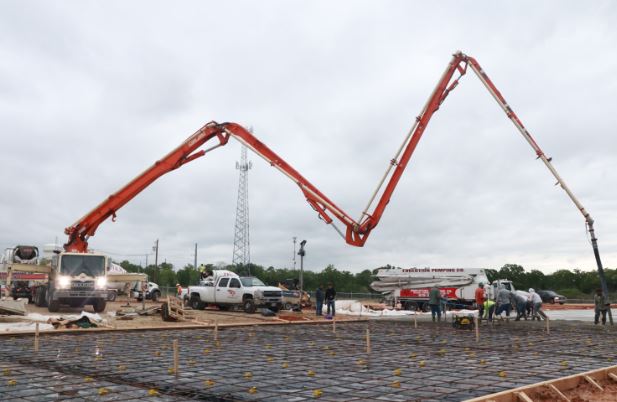
The simplest way to place concrete is straight from the truck, but a lot of projects are tucked behind houses, across yards, or on upper floors. The choice between the two depends on distance, height, volume, and the room available for equipment, and the choice of method is made well before the pour date.
What Happens on Site When a Pump Is Used
A pump needs more than a place to park. The mix must be fluid enough to pump and stiff enough to hold its shape afterward, and setup on soft or sloping ground can be dangerous without proper support. At pumping speed, forms, steel, and finishers all have to be ready before the first load, and a short meeting before the pour makes sure everyone knows their part.
Hazards to Plan For on a Concrete Site
A concrete site has several hazards at once. Boots, gloves, and eye protection are standard for anyone working in wet concrete, and a good plan treats safety as part of the schedule.
Prepping the Base So the Slab Does Not Move
Good subgrade preparation is the least visible and most important part of a pour. In clay country, soil movement is the main reason slabs crack and shift, so slabs and foundations are designed with that movement in mind. Rebar and wire mesh hold cracks tight and add strength, and a vapor barrier under a slab slows moisture from rising through it.
Placing Concrete in Heat, Wind, and Sudden Rain
Long hot summers are hard on fresh concrete, so hot-weather pours are usually scheduled for early morning. Shade, wind screens, and dampened subgrade help control surface drying, and the days after the pour matter as much as the day of the pour. Heavy rain on fresh concrete can damage the surface, wash out the mix, and ruin the finish, and rescheduling a pour for a better day is a normal and sensible decision.
Surface Finishes From Broom to Polish
Finishers work against the clock to give the surface its final shape. Stamped, exposed aggregate, and stained finishes add decoration but need their own steps, and the surface is a record of how well the timing went. Control joints cut into the surface create planned weak lines so cracks form there, and the difference between normal and serious cracking is worth understanding.
Concrete Around the Home
Houses, driveways, and backyards use more concrete than most people realize. A pool shell is a structural vessel that has to hold water and resist ground pressure, and there is no one-size-fits-all approach. Fences, trees, and utility lines can all affect how concrete gets to the forms, and walking the site with the contractor helps spot obstacles early.
Bigger Volumes and More Coordination
Larger sites bring engineered plans and testing requirements. A drilled shaft is a deep column of concrete poured into a bored hole to carry heavy loads, and a plan for deliveries keeps the pour continuous. Continuous delivery keeps fresh concrete from setting against concrete that has already stiffened, and planning ahead is what makes a large pour run smoothly.
Public Works: Streets, Highways, and Bridges
When the owner is a city, a state, or a federal agency, the specifications are detailed and strict, and samples are tested to confirm that the concrete meets the requirements. Work near traffic adds the need for lane closures, signs, and flaggers, and a contractor should understand what the agency expects before bidding on the work.
From the Plant to the Site: How Concrete Gets There
The plant is where the mix is controlled, and the truck is how it reaches the job, and each truck carries a limited amount, so large pours need several loads. The order should take into account the shape of the forms, the depth, and the subgrade, and a clear conversation about delivery windows prevents delays.
Some projects use equipment that is rented rather than delivered with the concrete. Who operates it, how much it can carry, what size of site it can reach, and how it is cleaned afterward, and the right match between equipment and site keeps the pour moving.
Neighbors and nearby properties are part of any concrete job. Choosing a delivery schedule that avoids school traffic and early-morning quiet, shows respect for the people who live next to the work.
What Happens After the Concrete Is Down
Placing concrete leaves behind equipment, forms, and washout that need to be handled. A good contractor has a plan for where the washout goes before the first truck arrives, and forms are removed at the right time, not too early. Where inspections are required, the contractor arranges them, and the finished concrete should be checked against the plans.
The Starting Point for a Pour That Goes Smoothly
When you are ready to turn Concrete Pouring in Bryan Texas into a schedule, Evolution Concrete BCS will gladly discuss how a project like yours would be planned. To begin, get in touch, and describe the site in your own words.