
Getting ready for Concrete Company in Bryan Texas?
Evolution Concrete BCS treats concrete as a job with a deadline built in once the material starts moving throughout Bryan Texas job sites.
Reach out to go over the schedule you are working toward.
Once the Truck Arrives, the Timer Is Running
Anyone weighing Concrete Company in Bryan Texas think first about the finished slab, driveway, or foundation, but the work that decides how it turns out happens in a short window. Once mixed, concrete begins a chemical process that cannot be paused, and every part of the site has to be prepared in advance.
Evolution Concrete BCS treats Concrete Company as a logistics problem as much as a materials problem and then builds the preparation around what the pour demands.
Mix Design, Workability, and the Water Question
Concrete is a mix of cement, water, sand, and stone. Strength, workability, and durability can be adjusted by changing the proportions and adding admixtures, and the strength and slump should be matched to the work. A truck that arrives with the wrong consistency can be sent back or adjusted, and adding extra water on site to make it easier to place weakens the finished concrete.
Admixtures and fibers give the mix extra abilities. Air-entraining agents help concrete resist freezing and thawing, plasticizers improve flow without adding water, and retarders slow the set in hot weather, and adding the wrong product can cause more trouble than it solves.
Getting Concrete From the Truck to Where It Goes
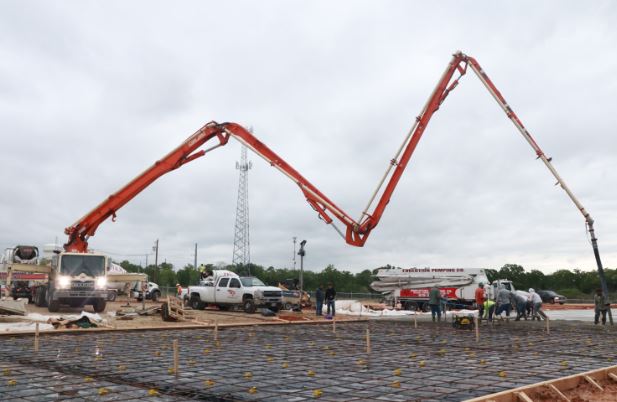
If a truck can back up to the forms, the chute does most of the work, but a lot of projects are tucked behind houses, across yards, or on upper floors. Each pump type has its own reach, capacity, and setup requirements, and overhead power lines and soft ground are two things that must be checked in advance.
Pumping Details: Priming, Reach, and Working Near Power Lines
The pump looks simple from the street, but the setup takes planning. The mix must be fluid enough to pump and stiff enough to hold its shape afterward, and the area around the equipment should be kept clear of anyone not working on the pour. The rate of placement sets the pace for everyone else on site, and the quality of the pour depends on how well that preparation was done.
Why Concrete Work Calls for Protective Gear and Planning
Few jobs bring so many moving parts together in so short a time. Fresh concrete is caustic and can burn skin and eyes after prolonged contact, and a good plan treats safety as part of the schedule.
What Goes Under the Concrete Matters as Much as the Concrete
Before any concrete arrives, the ground has to be shaped, compacted, and checked. In clay country, soil movement is the main reason slabs crack and shift, so thicker edges, steel reinforcement, and careful drainage become part of the design. Chairs and spacers hold reinforcement up so it does not end up on the ground, and a vapor barrier under a slab slows moisture from rising through it.
Planning a Pour Around the Forecast
Hot weather speeds up the chemistry that turns wet concrete into stone, so work often starts at dawn to finish before the afternoon heat. Chilled water, ice in the mix, and retarding admixtures can slow the set, and the days after the pour matter as much as the day of the pour. A cloudburst during a pour is an emergency, so covers are kept on hand, and rescheduling a pour for a better day is a normal and sensible decision.
What Finishers Do After the Concrete Is in Place
Finishers work against the clock to give the surface its final shape. Stamped, exposed aggregate, and stained finishes add decoration but need their own steps, and finishers watch the surface for the right moment to make each pass. Control joints cut into the surface create planned weak lines so cracks form there, and the difference between normal and serious cracking is worth understanding.
Concrete Around the Home
Few materials are used in so many places around a property. A house slab is the foundation of the structure and needs careful design for the soil, and a plan for each should account for how it will be used. Backyard access is often the biggest challenge, and walking the site with the contractor helps spot obstacles early.
Bigger Volumes and More Coordination
On commercial and industrial sites, pours involve more volume, more people, and more rules. A drilled shaft is a deep column of concrete poured into a bored hole to carry heavy loads, and the schedule has to coordinate trucks, pumps, finishers, and other trades. A big pour may need a steady stream of trucks arriving at precise intervals, and a good plan has backups for equipment and deliveries.
What Is Different About Public Projects
Public infrastructure has its own paperwork, testing, and inspection process, and the mix, the placement, and the curing are all documented. Night work is common on busy roads to reduce the effect on traffic, and planning for inspections and testing is built into the schedule.
Understanding Ready-Mix Supply and Delivery
The supply chain starts with the plant and ends with the placement, and each load has a time limit before it must be placed. A small allowance for uneven ground and spillage is common practice, and a steady rhythm of deliveries is the goal.
Mixer trucks, pumps, and placing equipment are sometimes arranged on their own. A heavy truck or pump needs firm ground and enough room to turn and set up, and the right match between equipment and site keeps the pour moving.
Trucks, pumps, and equipment take over streets and driveways for a few hours. Protecting curbs, lawns, and sprinkler lines along the route, is a courtesy that prevents many complaints.
Closing Out a Pour
When the pour is done, the work is not quite over. A good contractor has a plan for where the washout goes before the first truck arrives, and barricades keep people, pets, and vehicles off the surface until it is ready. Documentation of the work protects everyone involved, and a bit of care in the first weeks sets up the life of the surface.
The Starting Point for a Pour That Goes Smoothly
If Concrete Company in Bryan Texas is on your list, Evolution Concrete BCS can start with a conversation about the site, the access, and the size of the pour. Make contact to begin, and bring along any drawings or measurements you have.